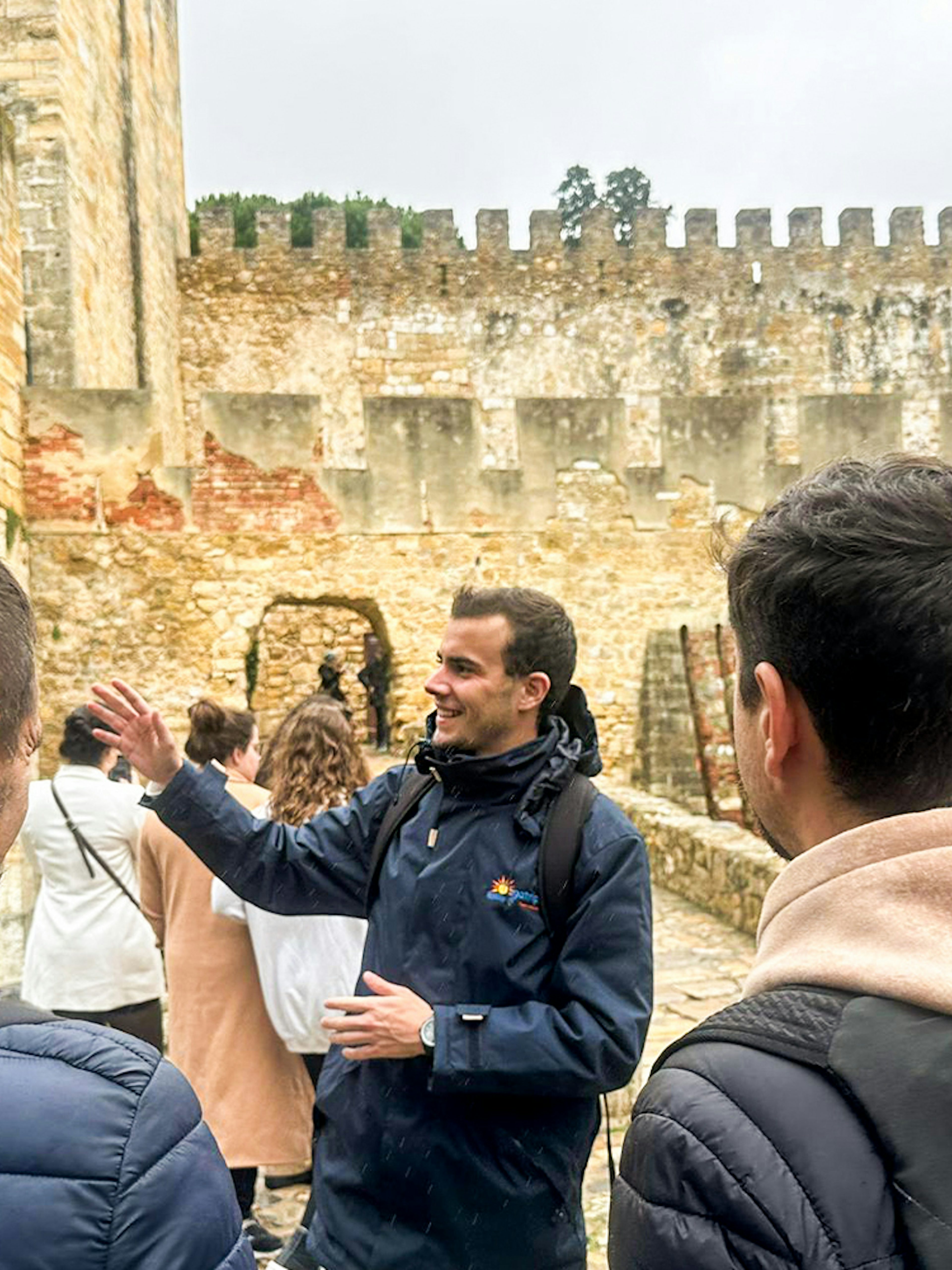






An expert multilingual guide turns the castle into a timeline of Lisbon, from its Islamic foundations to the 1147 conquest and the royal palace that once stood here. You won’t just look at battlements and ruins — you’ll understand why this hill mattered politically, militarily, and symbolically.
Top things to do in Lisbon
- Languages: English, Spanish, French, Italian, Portuguese
- Entry: Castle admission included
- Route add-on: Alfama walk available
- Access: Ramparts, gardens, museum
- Extras: Pastel de Nata tasting
- Terrain: Uneven paths, steep climbs
Why choose a guided tour
✔ Learn Lisbon beyond the walls
✔ Spend time exploring, not decoding
São Jorge Castle is spread across walls, towers, palace ruins, gardens, and museum rooms. A guided route helps you cover the major sections without zigzagging or missing the context behind spaces like the Place-of-Arms, the Alcáçova ruins, and the archaeological collections.
✔ Understand the view, not just photograph it
The panoramas are one of the castle’s biggest draws, but they make more sense when an expert guide points out Alfama, the Tagus River, Lisbon Cathedral, and the downtown grid below. The view becomes orientation, not just scenery.
✔ Ask real questions as you go
A live guide means you can pause on the details that interest you most, whether that’s Moorish Lisbon, siege history, royal life, or the artifacts in the museum rooms. The experience feels more responsive than reading scattered signs across a large hilltop site.
What to expect on a guided tour of São Jorge Castle

Meet your guide at the hilltop entrance
Your visit starts near the main castle entrance on Rua de Santa Cruz do Castelo. Arrive a little early, as the approach is uphill and the site opens onto uneven stone surfaces almost immediately. After entry, the guided route usually begins in the main open areas before moving toward the walls.
Start with the castle’s big-picture history
The opening section introduces the fortress as more than a viewpoint. An expert English-, Spanish-, French-, Italian-, or Portuguese-speaking guide explains how the hill was occupied across different eras, including Islamic Lisbon and the later royal residence, so the layout makes sense before you climb.
Walk the ramparts and look across Lisbon
From the walls and towers, the castle reveals its strategic logic. This is where the guided format pays off: the city below stops being a postcard and becomes a map of old Lisbon, with Alfama’s lanes, Lisbon Cathedral, the Baixa grid, and the Tagus all tied back to the fortress’s defensive role.
Move through the palace ruins and museum spaces
The route usually shifts from open-air fortifications to the remains of the former royal palace and the museum centre. Here, archaeology gives the story texture — Islamic ceramics, Roman traces, and objects linked to later Lisbon help explain what stood here before the 1755 earthquake reshaped the city.
Finish with time to linger or continue into Alfama
After the guided portion, you can usually stay on and revisit viewpoints, gardens, and quieter corners at your own pace. If you’ve booked the upgraded option, the experience continues downhill into Alfama, where the castle’s history connects naturally to one of Lisbon’s oldest neighborhoods, plus a Pastel de Nata and Ginjinha tasting.
Which guided tour is best for you
São Jorge Castle guided tour
Duration: Approximately 1–2 hours inside the castle
Group size: Shared group
Languages: English, Spanish, French, Italian, Portuguese
This is the strongest fit for first-time visitors who want the castle explained clearly without turning the visit into a half-day commitment. The route focuses on the fortress itself — the battlements, viewpoints, courtyard, and core historical context — so you come away with a solid understanding of why this hilltop site mattered to Lisbon for centuries. It’s also the easiest choice if your main goal is to pair history with views and then continue exploring on your own afterward.
Popular option:
● São Jorge Castle Guided Tour
São Jorge Castle guided tour + Alfama walk
Duration: Longer route with castle visit and neighborhood add-on
Group size: Shared group
Languages: English, Spanish, French, Italian, Portuguese
Choose this version if you want the castle to feel like part of a wider old-Lisbon story, not a standalone monument. After the guided castle visit, the experience extends into Alfama, where the city’s steep lanes and layered history continue beyond the fortress walls. The tasting of Pastel de Nata and Ginjinha adds a local finish, so this option suits travelers who prefer context, walking, and neighborhood atmosphere over a shorter in-and-out visit.
Popular option:
● São Jorge Castle Guided Tour
Highlights covered on the tour

1. Castle ramparts and battlements

Location: North and west walls
Walk the defensive walls that once controlled Lisbon’s highest hill. The real draw is how military architecture opens into citywide views.


Things to keep in mind when you go on a tour
- Restrooms: Available inside the castle complex near the main visitor areas; use them before heading onto the walls and upper terraces.
- Café terrace: Located within the grounds; useful for a mid-visit break with views over Lisbon.
- Seating areas: Found in the courtyard and garden zones; the best places to pause after climbing stairs and uneven paths.
- Museum Centre: Indoor exhibition space within the former palace area; a good stop if you want shade and historical context.
- Sturdy walking shoes: The route includes rocky paths, old paving, steps, and uneven surfaces across the hilltop complex.
- Water bottle: The open-air sections get hot quickly, especially from late morning onward.
- Hat and sunscreen: Large parts of the walls and viewpoints are exposed, with limited shade during sunnier hours.
- Light bag only: Large bags and backpacks are not permitted, so pack minimally for an easier check-in and walk.
- Large bags and backpacks are not allowed inside the castle complex.
- Tripods and bulky camera equipment should be avoided, as they obstruct narrow walkways and viewpoints.
- Pets are not allowed, except for service animals.
- Stay on marked visitor routes and take care on the walls, where surfaces can be uneven and exposed.
- Respect the archaeological areas and displays; touching artifacts and ruins is not permitted.
- Choose an early slot: The castle gets busier later in the day, and morning visits make the walls and viewpoints easier to enjoy.
- Allow extra time after the tour: The guided route gives structure, but you’ll probably want more time for photos, museum rooms, and the gardens.
- Use the Alfama upgrade strategically: It’s the better pick if you want the castle visit to flow into Lisbon’s oldest neighborhood in one continuous experience.
- Expect an uphill approach: Even before the tour starts, getting to the entrance involves climbing through the old city.
- Check same-day access to special features: Seasonal or operational changes can affect areas like the wall walks later in the day.
- Wheelchair access: Limited, due to steep slopes, steps, and uneven historic terrain across the complex.
- Mobility limitations: Not recommended for many visitors with reduced mobility because the route includes climbs, stone paths, and prolonged standing.
- Strollers: Access is limited; the surfaces and gradients make maneuvering difficult in several sections.
- Pacing: The courtyard and garden areas offer some places to rest, but the overall visit still involves a fair amount of walking.
Frequently asked questions about São Jorge Castle guided tours
A guided tour is better if you want structure, live questions, and a clearer explanation of how the walls, palace ruins, and museum sections connect. An audio guide suits travelers who prefer complete pacing freedom and want to linger at viewpoints or move independently.
Headout’s guided experience includes an expert live guide in English, Spanish, French, Italian, or Portuguese, depending on the option you choose. While a formal license type is not listed in the inventory, the guide’s role is to interpret the castle’s history, layout, and major viewpoints in real time.
Expect a fairly active visit with uphill access, stone paths, stairs, and uneven surfaces throughout the complex. Most visitors spend about 1–2 hours on site, and the walking feels more demanding than a flat museum because of the gradients and exposed wall sections.
Yes, for many families it is. The open courtyard, views, peacocks, and shorter outdoor stops keep the visit engaging, but very young children may tire on the hills, steps, and uneven ground. The shorter castle-only guided option is usually easier than adding the Alfama walk.
It depends on mobility level, but many seniors who are comfortable with hills and stairs still enjoy it. For people with reduced mobility, the castle is challenging because access is limited, surfaces are uneven, and some routes involve steep sections that can’t be easily avoided.
Yes. Once the guided portion ends, you can usually stay inside and continue through the grounds at your own pace. That’s useful if you want extra time for the views, the museum rooms, or a quieter break in the courtyard after the structured route finishes.
Only if you book the upgraded option. The standard experience focuses on São Jorge Castle itself, while the extended version continues into Alfama and may also include a Pastel de Nata and Ginjinha tasting.
Yes. The guided experience includes castle entry, and admission covers the main outdoor areas plus the museum centre. That means the visit can combine ramparts, gardens, palace ruins, and archaeological displays in one ticketed experience.
The camera obscura in the Tower of Ulysses is included with castle admission, but it operates on scheduled sessions and isn’t guaranteed as part of every Headout guided-tour route. If it matters to you, check the same-day timetable once you’re inside.
Depending on the option selected, live guided tours are available in English, Spanish, French, Italian, and Portuguese. Choose your language at booking, since not every departure is necessarily offered in every language on the same day.
Yes — sturdy shoes, water, and sun protection matter more here than at a typical indoor attraction. The site is exposed, and the ground is uneven. If you normally carry a large backpack, switch to a smaller bag because bigger bags aren’t allowed.
Access is limited for both. The castle’s historic layout includes steep climbs, stairs, and uneven paving, so wheelchair users and many stroller users will find parts of the route difficult or inaccessible. It’s best to choose this tour only if you’re comfortable with those constraints.
More reads
Not applicable.
Getting to São Jorge Castle
Plan the easiest route to the castle entrance.
What to know before visiting São Jorge Castle
See practical tips, timings, and entry information.
Top Lisbon landmarks to pair with your visit
Explore nearby attractions and smart combo options.